Allowances without specifications
A cabinet, tile, fixture, or hardware allowance is only useful when quantity, product level, tax, delivery, labor, and the overage-or-credit method are understood.

Estimate comparison guide
Two remodeling proposals can show different totals because they are pricing different work. Compare the scope line by line—especially allowances, exclusions, connected trades, permit responsibility, and concealed-condition procedures—before deciding which estimate is actually lower.
The short answer
Create one comparison sheet and give each contractor a column. If a proposal does not clearly say whether an item is included, excluded, or an allowance, mark it “unclear” instead of assuming it is covered.
| Comparison line | What a useful proposal clarifies | Question to ask |
|---|---|---|
| Demolition and disposal | What is removed, what is protected, hauling, containers, and disposal. | Does this include every existing finish and fixture shown in the scope? |
| Materials and allowances | Specified products versus placeholders, quantities, tax, delivery, and labor. | What selection can I actually buy within each allowance? |
| Connected trades | Carpentry, plumbing, electrical, mechanical, drywall, tile, flooring, trim, and paint. | Which trades are included, and which must I hire separately? |
| Permits and inspections | Responsibility for confirmation, submittals, fees, access, corrections, and inspection sequencing. | What is included in this total and what is paid separately? |
| Site protection and cleanup | Dust barriers, floor protection, daily cleanup, debris path, and final cleanup. | Which occupied areas are protected and how? |
| Schedule assumptions | Start conditions, selection deadlines, lead times, inspections, access, and change impacts. | What must happen before the stated duration begins? |
| Concealed conditions | What was observed, what could not be seen, and the approval process for added work. | How will a hidden condition be documented and priced? |
| Exclusions | A direct list of work, products, repairs, and owner responsibilities outside the total. | What would I still need to purchase, coordinate, or repair? |
The gaps that change totals
The headline number can be precise while the underlying assumptions remain incomplete.
A cabinet, tile, fixture, or hardware allowance is only useful when quantity, product level, tax, delivery, labor, and the overage-or-credit method are understood.
“Install kitchen” can conceal whether plumbing, electrical, ventilation, wall repair, trim, paint, and flooring transitions are part of the same number.
A duration means little unless you know when the clock starts and which permits, selections, deliveries, inspections, and homeowner decisions it assumes.
Existing homes contain areas that cannot be fully evaluated before demolition. The proposal should explain the evidence, approval, price, and schedule process if something is uncovered.
A fair comparison
A one-page brief reduces accidental scope differences without telling a contractor how to build the project.
Ask what explains the price difference: a different approach or material, work left out of the proposal, responsibility passed to you, or a lower cost for the same result.
Before signing
Ask for written clarification where the proposal uses broad phrases or leaves a connected trade unaddressed.
When possible, select products or define a measurable level before the contract so fewer decisions remain as placeholders.
Identify who orders, receives, stores, protects, submits, schedules, inspects, cleans, and corrects each part of the project.
Understand how added or deleted scope changes price and time, and who must approve it before the work proceeds.
Apply the checklist to real work
Use the seven-photo two-tone kitchen to work through what each proposal includes. Comparing the same items makes the price difference easier to understand.
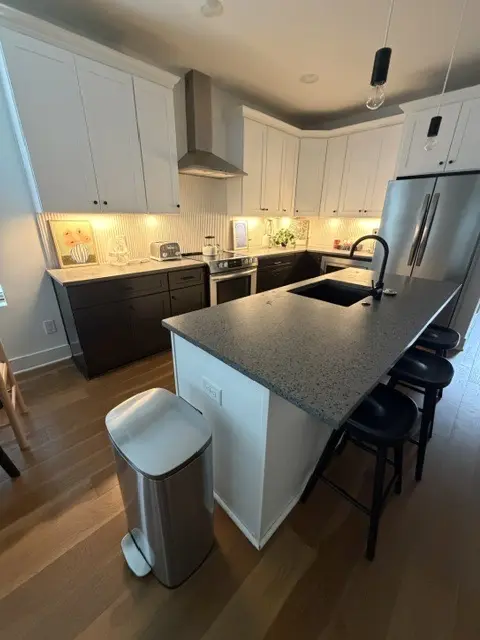
A lower proposal may omit backsplash, flooring limits, appliance connections, island plumbing, under-cabinet lighting, quartz edge and cutout details, site protection, permits, or final paint and trim. Another may include all of them.
Open the seven-photo scope profile →| Visible item | Comparison question | Common ambiguity to remove |
|---|---|---|
| Two-tone cabinetry | Are all boxes, panels, trim, hardware, delivery, and installation included? | “Cabinets included” without construction level, quantity, or finished ends. |
| Quartz island and counters | Does the number include templating, seams, edges, sink cutout, support, and backsplash? | An allowance that covers slab material but not the same fabrication scope. |
| Island sink and lighting | Are plumbing, power, fixtures, switching, patching, and inspections included? | Trade work assigned to the homeowner or excluded from the headline total. |
| Flooring and finish work | Where does flooring stop, and who handles transitions, wall repair, paint, and trim? | A completed-looking photo compared against a proposal that ends before final finishes. |
Clear answers
Not until the proposals are normalized. A lower total may omit a trade, use smaller allowances, exclude protection or repairs, or assign more responsibility to the homeowner.
An allowance is a placeholder amount for an item or selection that is not yet fully specified. Ask what it covers, whether labor and tax are included, and how overages or credits are handled.
The proposal should make responsibility clear: who confirms requirements, who prepares and submits information, who pays listed fees, and how inspections affect sequencing.
Compare the assumptions behind each schedule, including selection deadlines, permit timing, material lead times, access, working hours, inspection dependencies, and how changes affect completion.
The proposal should explain how concealed conditions are documented, priced, approved, and added to the schedule before extra work proceeds, except when immediate safety protection is necessary.
Sources and limits
Use this checklist to make competing scopes easier to compare. It does not replace reading the full proposal, confirming current permit requirements, checking credentials, or obtaining legal advice about contract terms.
Free in-home consultation
Tell us which room you’re remodeling, your address, the work you need, and the budget range you want to stay within.